← Back to Research

Additional Publications

Additional first-author publications and papers with significant contribution — hover over a card to see details and open the ADS record.

Key figure from paper 7

Outbursting Disks Have Enough Mass to Form Massive Planets

Calahan, J.K., Bergin E.A., van't Hoff M. et al.  ·  Astrophysical Journal 967, 2 (2024)

High Mass Inner Regions Found in Five Outbursting Sources

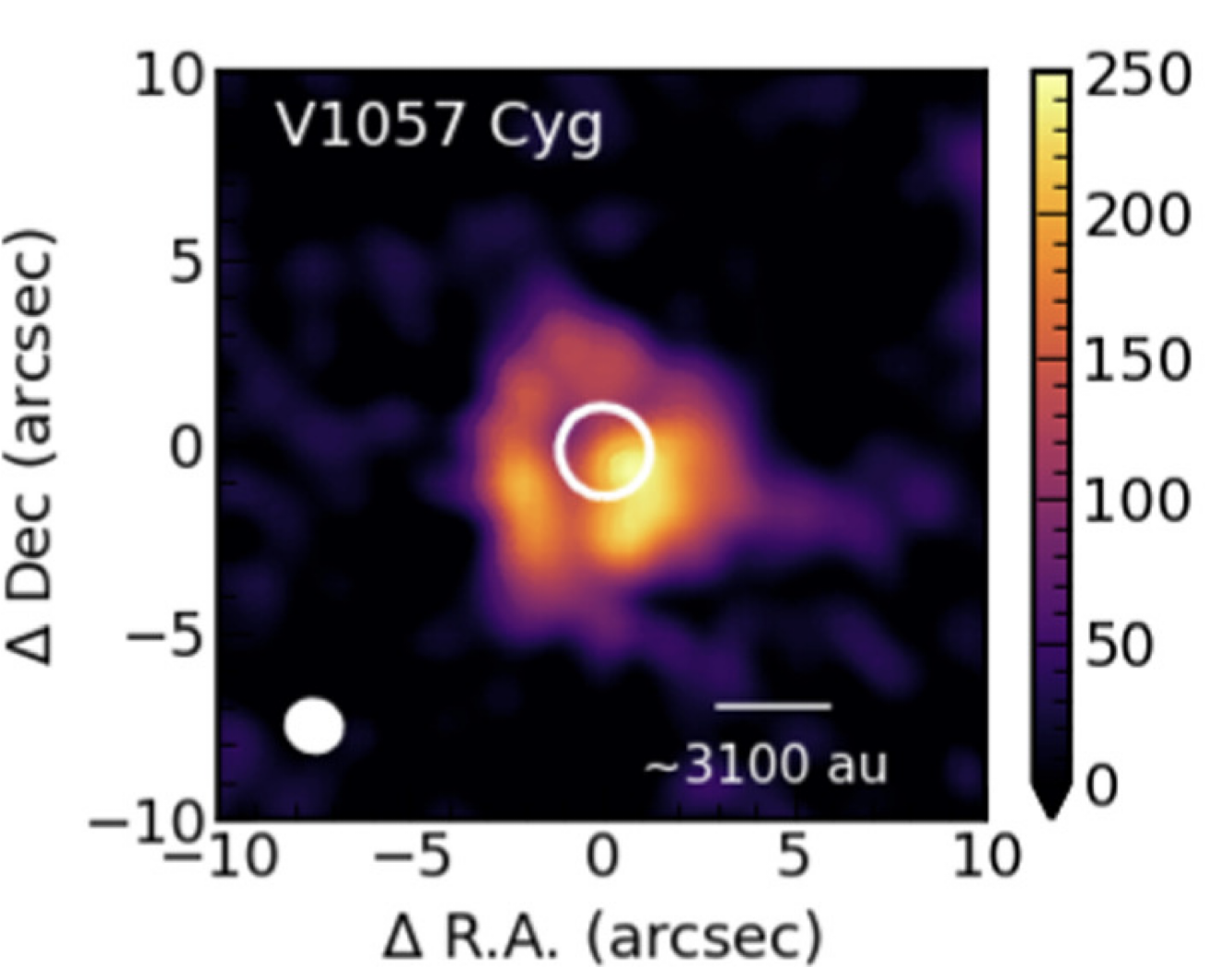
Using NOEMA, I targeted 5 outbursting sources and was sensitive to four CO isotopologues. All 5 had optically thin emission of C17O, and I used this to determine a mass within ~1000 au around each star. All 5 sources proved to be gravitationally unstable within this region.

hover for details →
Key figure from paper 6

Chemical Accounting of an Outbursting Object with NOEMA

Calahan, J.K., Bergin E.A., van't Hoff M. et al.  ·  Astrophysical Journal 975, 2 (2024)

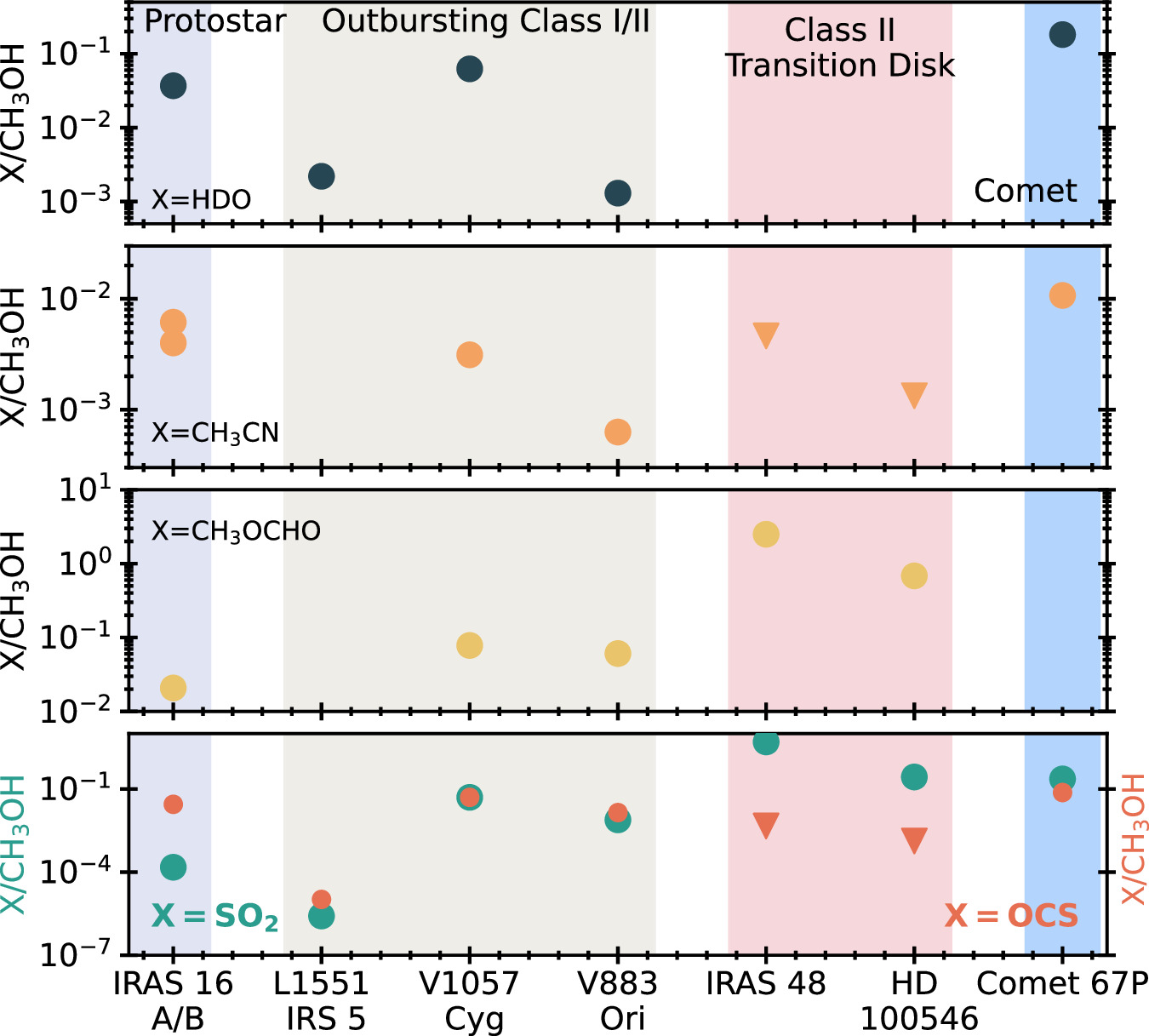
Complex Organics Surrounding the FU Ori─type Object V1057 Cyg Indicative of Sublimated Ices

V1057 Cyg is a classic FU Ori-type object, a suspected binary system that still has a enough mass within 1000 au to be considered gravitationally unstable. This source stood out in our NOEMA survey as being very line-rich, with strong detections of multiple complext organic molecules, sulfur bearing molecules, and a ~3 sigma detection of HDO. V1057 Cyg then is used as a chemical bridge, connecting between protostars, protoplanetary disks, and comets.

hover for details →
Key figure from paper 5

Taking the Temperature of a Massive Planet-hosting Disk

Calahan, J.K., Bergin E.A., Zhang Ke et al.  ·  Astrophysical Journal Supplemental Series 257, 1 (2021)

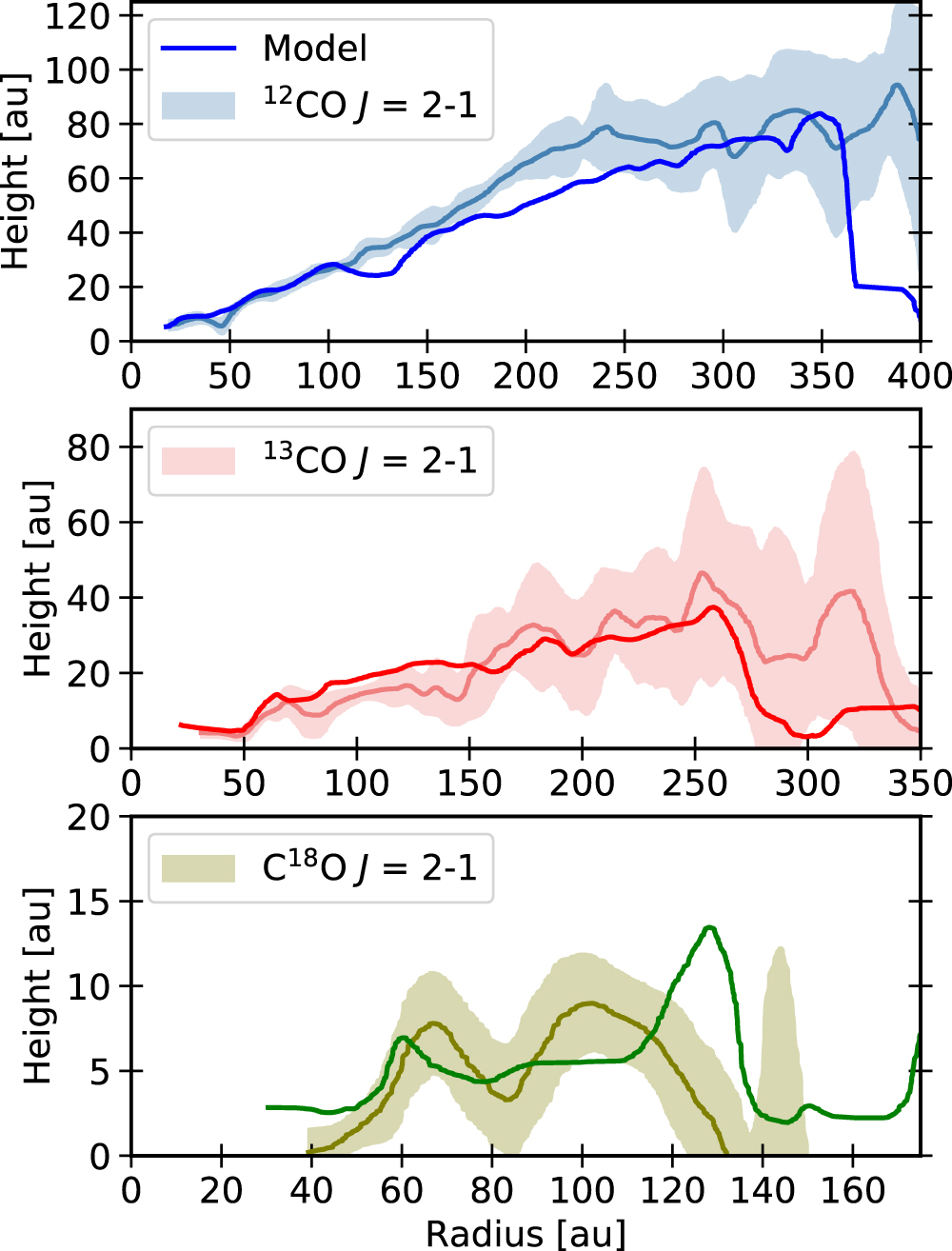
Molecules with ALMA at Planet-forming Scales (MAPS). XVII. Determining the 2D Thermal Structure of the HD 163296 Disk

I reproduce the spatially resolved CO emission and SED in the HD 163296 protoplanetary disk, and produce a 2D temperature structure that has been used for future chemical modeling and planet formation studies. HD 163296 has large gaps and rings, and I explore the impact of assumed gas depletion within those dust gaps, and see that within the gap the temperature can increase by 10% and the local UV field is elevated.

hover for details →
Key figure from paper 8

Hunting for Inflow in Starless Cores

Calahan, J.K., Shirley Y., Svoboda B. et al.  ·  Astrophysical Journal 862, 1 (2018)

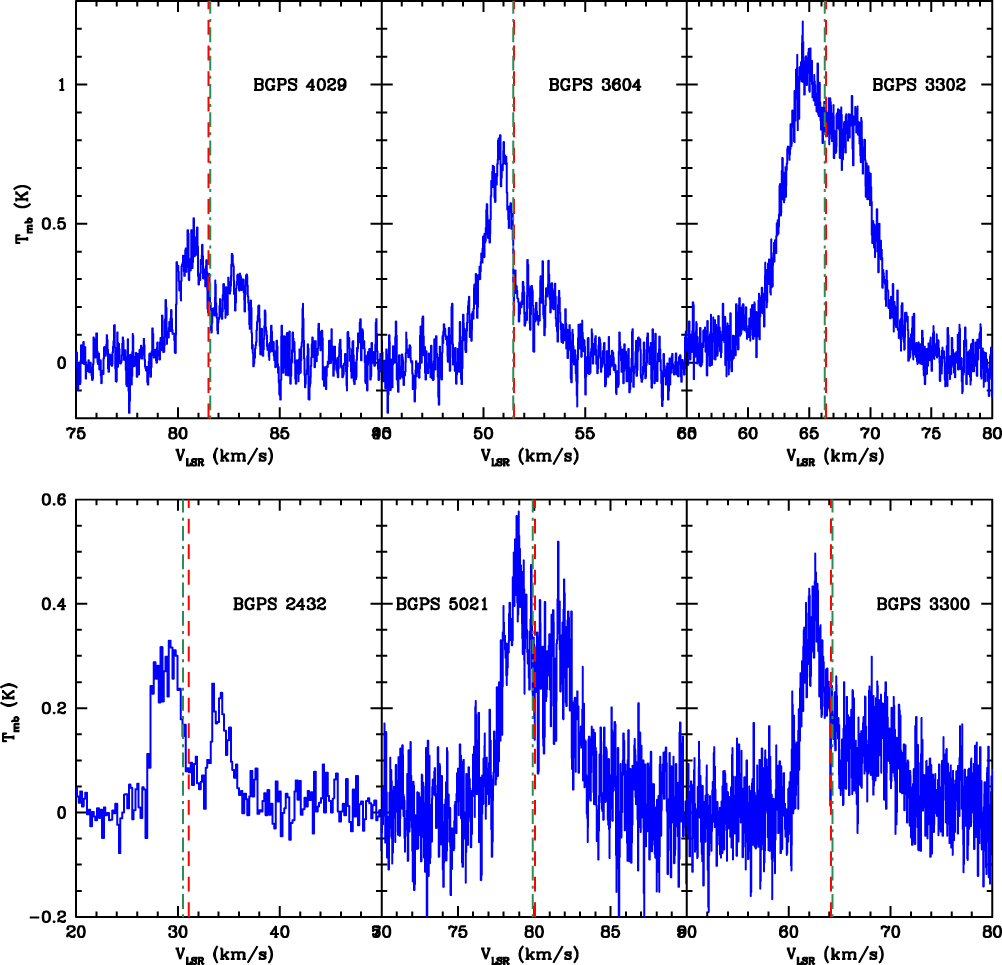
Searching for Inflow toward Massive Starless Clump Candidates Identified in the Bolocam Galactic Plane Survey

The first sign of star formation is infall within a core of dust and gas. Using the Bolocam Galactice Plane Survey, we followed up 101 starless cores with the 12m telescope on Kitt Peak, looking for signs of infall in the HCO+ 1-0 line. We find that 6% of our sample show infall motion. This project was also a teaching opportunity for the Astronomy Club at the University of Arizona, and most co-authors were fellow undergraduates that I brought to the telescope, and I taught them about the project, and how to help with observations.

hover for details →